
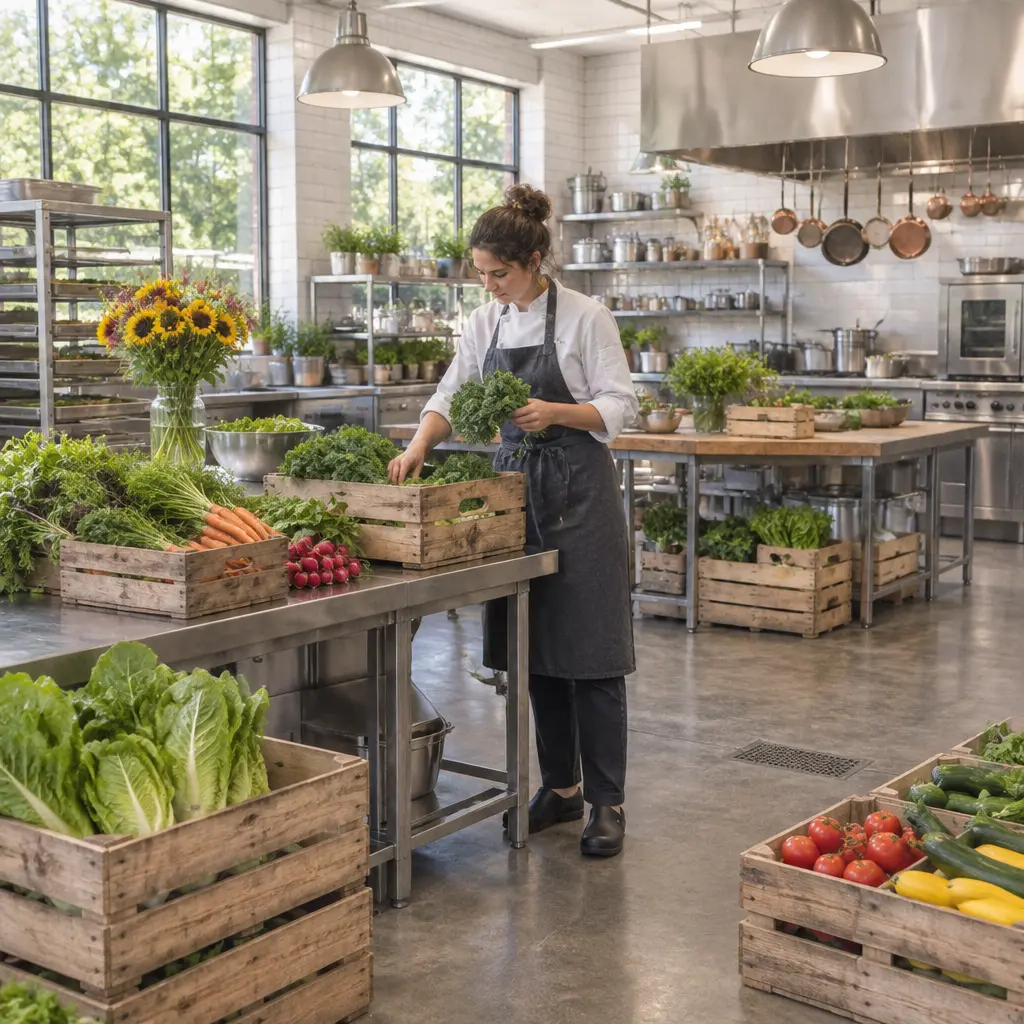
Seasonal menu authenticity means designing dishes around ingredients that are genuinely available from nearby farms, fisheries, and other suppliers during the relevant harvest or growing period—not simply labeling familiar dishes “seasonal.” A reliable approach combines local harvest calendars, supplier confirmation, preservation, and flexible menu planning. The distinction matters: the U.S. Department of Agriculture’s 2022 Census of Agriculture counted more than 116,000 farms selling directly to consumers, while the National Restaurant Association identifies locally sourced food and sustainability among consumer-facing restaurant trends. Harvest-led menus can strengthen flavor and provenance, but only when kitchens acknowledge regional variation, weather, and supply limits.
Seasonal Menu Authenticity: Definition and Harvest-Based Planning
“Seasonal” has no single universal calendar definition. In practical menu planning, seasonal authenticity is the degree to which a dish’s ingredients reflect what is actually being harvested, landed, or stored in the restaurant’s defined sourcing region at that time. The definition should be specific about place, season, and sourcing: a winter squash may be locally harvested in autumn and still be available from storage in winter, while fresh asparagus may be seasonal in one region and imported in another.
The USDA’s National Agricultural Statistics Service documents crop production and agricultural conditions, while state extension services and regional food hubs often provide more local planting and harvest guidance. These sources are useful starting points, not guarantees of what a particular supplier can deliver. Actual availability depends on weather, crop varieties, storage, transport, and competing demand.
That distinction leads to the core operational rule: use calendars to anticipate possibilities, then verify them with growers and suppliers before making a promise on the menu. The related practices include harvest-calendar planning, supplier verification, flexible dish design, and preservation for periods when fresh harvests are limited.
Harvest calendars define a regional starting point
A harvest calendar is a planning guide showing when crops are commonly planted, harvested, or available from storage in a specified area. It helps chefs identify likely ingredients and plan menu development, but it is not a real-time inventory report. The USDA’s seasonal produce guidance and university extension calendars can help map broad patterns; local growers provide the most relevant updates for individual farms and varieties.
For example, a restaurant in the Pacific Northwest might plan around cool-season greens and stored apples in winter, while a restaurant in the Southwest may have access to different winter vegetables. Even within one region, elevation and microclimate can shift harvest timing. A calendar should therefore be treated as a forecast to be checked, not proof that an ingredient is currently available.
Supplier confirmation turns intention into evidence
Supplier confirmation means checking the ingredient’s origin, harvest or landing date, quantity, grade, and expected delivery directly with the farm, fishery, distributor, or food hub. This step protects authenticity because a product’s name alone does not establish where or when it was produced. The USDA defines local food through several possible market arrangements rather than one universal distance threshold, so restaurants should state their own sourcing boundary clearly.
A practical purchasing log can record supplier, farm or landing location, product, delivery date, and substitutions. The USDA’s 2022 Census of Agriculture reported 116,617 farms with direct-to-consumer sales, illustrating the scale of direct marketing, though that figure does not mean every restaurant can source all products directly. Regional food hubs and distributors can connect restaurants to multiple producers while preserving traceability.
Harvest-Led Menus Improve Integrity Through Flexible Design
Once a restaurant knows what is plausibly available, menu design must absorb ordinary variation without misleading guests. A harvest-led menu is built around adaptable techniques and ingredient roles rather than rigid recipes that depend on one crop arriving in a precise volume. This approach is especially relevant because the USDA’s National Agricultural Statistics Service tracks weather and crop conditions precisely because agricultural output varies from year to year.
Flexibility does not mean vagueness. Restaurants can identify the source and season accurately while explaining that a dish may change when harvests shift. The strongest systems connect menu language, purchasing decisions, kitchen preparation, and staff communication.
Flexible recipes accommodate weather and supply changes
A flexible recipe specifies a culinary function—such as a roasted root vegetable, a tart fruit, or a leafy herb—alongside acceptable seasonal substitutions. The chef can preserve the dish’s structure while changing the particular crop when a supplier’s harvest changes. For instance, a roasted-vegetable plate might feature carrots early in the season and parsnips later, provided the menu description is updated when the named ingredient changes.
This method reduces the risk of promising a scarce ingredient and makes purchasing more responsive. It also helps kitchens use produce at different stages of maturity, although food safety, quality, and recipe testing remain essential. The National Restaurant Association’s industry reporting regularly highlights operators’ attention to costs, sourcing, and supply challenges; flexible specifications are one practical way to manage those pressures without presenting substitutions as the original product.
Preservation extends the harvest without pretending it is fresh
Preservation includes freezing, drying, fermenting, canning, pickling, and controlled storage to retain seasonal ingredients beyond their harvest window. It allows a menu to use a summer berry conserve in winter or serve stored root vegetables after field harvest ends. The important distinction is transparency: preserved ingredients can be seasonal in origin, but should not be described as freshly harvested when they are not.
The National Center for Home Food Preservation, hosted by the University of Georgia, provides tested guidance on safe preservation methods. Commercial kitchens must follow applicable food-safety rules and validated processes rather than adapting home-preservation instructions without review. Preservation can also reduce waste, but its benefits depend on safe handling, appropriate storage, and a realistic accounting of labor and energy.
Menu language makes provenance understandable
Provenance language tells diners where an ingredient came from and, when relevant, whether it was fresh, stored, or preserved. Concise descriptions such as “local winter squash from a regional farm” are more informative than an unsupported “farm-to-table” claim. Restaurants should avoid implying that every ingredient is local when only one component is sourced nearby.
Staff should be able to explain the restaurant’s sourcing radius, the reason a dish changed, and whether an ingredient is seasonal but stored. This is not merely a marketing detail: clear claims help guests distinguish local origin, seasonal availability, and production method, which are related but not interchangeable ideas.
Harvest Reality Requires Regional and Ecological Context
A menu can be locally sourced yet fail to reflect harvest reality if it ignores regional ecosystems, fishing seasons, or the limits of a particular crop. Authentic planning therefore extends beyond produce to seafood, livestock, storage crops, and the environmental conditions that shape supply. It also recognizes that “local” is a geographic claim, whereas “seasonal” is a claim about timing and availability.
Regional differences prevent one-size-fits-all seasonality
Regional seasonality is the pattern of availability determined by local climate, soils, water, growing practices, and infrastructure. A national seasonal chart can offer broad guidance, but it cannot reliably specify harvest dates for every county or farm. USDA hardiness zones describe average annual extreme minimum temperatures and are useful for understanding plant adaptation, yet they do not by themselves predict a crop’s harvest date or a supplier’s inventory.
Restaurants can make regional context visible by naming a sourcing area and explaining how storage or greenhouse production affects availability. That precision avoids the mistaken assumption that the same ingredient is “in season” everywhere at the same time.
Seafood seasonality must account for regulations and sustainability
Seafood availability is shaped by species biology, fishing seasons, closures, quotas, weather, and aquaculture practices. The National Oceanic and Atmospheric Administration’s Fisheries service publishes information on managed fisheries and regulations; state agencies may provide additional local rules. A fish’s presence in a market does not, by itself, establish that it was harvested sustainably or locally.
Menus should identify species accurately and rely on trusted suppliers for harvest location and method. Where a species is unavailable or a fishery is closed, a planned substitution should follow the same sourcing and disclosure standards as produce substitutions. This connects harvest authenticity with responsible purchasing rather than treating seasonality as a purely culinary question.
Case example: a harvest-responsive autumn menu
Consider a restaurant that plans an autumn menu around apples, brassicas, and root vegetables. It consults a regional calendar, then confirms crop varieties and weekly volumes with farms. If a wet harvest delays one variety of apple, the kitchen can use another locally available cultivar and revise the menu description. If a root crop is stored, the staff describes it as a stored local harvest rather than newly picked produce.
The example illustrates a simple evidence chain: forecast, confirm, purchase, describe, and update. Restaurants can track performance through the share of menu items with verified origin, frequency of substitutions, food waste, and the proportion of purchasing from defined regional sources. These are operational measures, not universal industry benchmarks, so each business should establish a baseline and report its method consistently.
Conclusion: Lock Menus to Verified Harvests, Not Assumptions
Seasonal menu authenticity begins with a clear definition of place and season, uses harvest calendars as planning tools, and relies on supplier confirmation before making sourcing claims. Flexible recipes and safe preservation help kitchens respond to weather and supply variation, while accurate menu language distinguishes fresh, stored, and preserved ingredients. Regional crop patterns and seafood rules further show why one universal seasonal calendar is inadequate.
For restaurant operators, the next step is to define a sourcing region, build relationships with suppliers, maintain a simple origin-and-delivery log, and review menu claims whenever availability changes. For diners, asking where an ingredient came from—and whether it is fresh or stored—can encourage greater transparency. Harvest-led menus are most credible when they treat seasonality as a verifiable supply practice, not a decorative label.
Sources: U.S. Department of Agriculture, 2022 Census of Agriculture, https://www.nass.usda.gov/Publications/AgCensus/2022/; U.S. Department of Agriculture, Local Food Directories and Resources, https://www.ams.usda.gov/services/local-regional; U.S. Department of Agriculture, Seasonal Produce Guide, https://snaped.fns.usda.gov/resources/nutrition-education-materials/seasonal-produce-guide; National Restaurant Association, What’s Hot Culinary Forecast, https://restaurant.org/research-and-media/research/whats-hot/; National Agricultural Statistics Service, Crop Progress and Condition, https://www.nass.usda.gov/Publications/Ag_Statistics/; National Center for Home Food Preservation, University of Georgia, https://nchfp.uga.edu/; National Oceanic and Atmospheric Administration Fisheries, Fishery Management Plans, https://www.fisheries.noaa.gov/national/laws-and-policies/fishery-management-plans


