Custom menus are planned food and beverage selections shaped around guests’ dietary needs, preferences, and the event’s shared dining experience. An inclusive menu builds allergen-safe, religiously appropriate, and plant-based choices into the same courses and service plan as other dishes, rather than marking affected guests for separate or conspicuous plates. This approach matters: the U.S. Centers for Disease Control and Prevention estimates that food allergies affect about 1 in 13 children in the United States, while the Food Allergy Research & Education organization estimates that 33 million Americans have food allergies. Thoughtful menu design, accurate ingredient information, kitchen controls, and discreet service can make participation safer and more welcoming.
Inclusive Custom Menus Integrate Dietary Restrictions into Shared Dining
A custom menu is a food plan adapted to an occasion, its guests, its budget, and its practical service conditions. Inclusivity means that guests with restrictions can enjoy a meal that is nutritionally and socially comparable to the standard offering. It does not mean concealing ingredients or promising safety that a kitchen cannot guarantee. Instead, planners identify needs early, choose dishes that naturally suit multiple diets, verify preparation methods, and communicate options privately and clearly.
The distinction is important because dietary needs are not interchangeable. A vegetarian meal may still contain dairy; a gluten-free dish may be unsuitable for someone with celiac disease if cross-contact occurs; and a halal or kosher guest may require specific sourcing and preparation, not merely the removal of pork. The sections below explain how inclusive menu design is defined, how it can be implemented without segregated plating, and how organizers can validate safety and service quality.
Inclusive Menu Design Defines Custom Menus Around Shared Participation
Inclusive menu design is the planning of food, preparation, labeling, and service so that guests with different dietary requirements can participate in a common dining experience with suitable choices. The U.S. Department of Justice describes disability-related dietary accommodations as potentially necessary for equal access in covered settings; in practice, event planners should also consider medical, religious, ethical, and personal needs. Inclusion is achieved through options and reliable processes—not by assuming that one recipe suits everyone.
The main characteristics are early information gathering, ingredient transparency, intentional recipe selection, cross-contact controls where needed, and equivalent presentation. Related forms include allergen-aware menus, gluten-free menus, plant-based menus, religiously compliant menus, and flexible menus that let guests select components. These categories overlap, but they should not be treated as synonyms: each has distinct ingredients, sourcing rules, and risk controls.
Dietary Needs Are Distinct Categories, Not a Single “Special Diet”
Dietary restrictions may arise from allergies, intolerances, medical conditions, religious observance, ethics, or preference. A food allergy involves an immune response and can be serious; an intolerance, such as lactose intolerance, generally involves difficulty digesting a food and is different in mechanism and risk. The U.S. Food and Drug Administration identifies nine major food allergens in the United States: milk, eggs, fish, crustacean shellfish, tree nuts, peanuts, wheat, soybeans, and sesame.
Celiac disease is an autoimmune disorder triggered by gluten, so merely removing visible wheat from a plate may not be adequate if preparation surfaces or utensils are shared. Religious requirements can also involve sourcing and handling: halal and kosher observance, for example, may depend on certification or preparation practices. Request the guest’s requirements in their own terms, ask what level of precaution is needed, and avoid making assumptions based on a diet label.
Shared-Menu Planning Uses Naturally Inclusive Dishes
A shared menu is a collection of dishes designed so that multiple guests can select suitable food from the same meal service. Rather than creating a visibly different plate for each person, planners can make several core dishes compatible with common needs—for example, a bean-and-vegetable entrée that is vegan and gluten-free by recipe, alongside clearly identified sides and sauces. This can reduce the number of separate preparations while preserving choice.
“Naturally inclusive” does not mean universally safe. A dish that contains no declared allergen in its recipe could still be exposed through shared equipment, cooking oil, garnishes, or supplier ingredients. The menu should therefore distinguish recipe suitability from verified allergen controls, and staff should never describe a dish as allergen-free unless the operation can substantiate that claim.
Equivalent Presentation Protects Dignity and Guest Experience
Equivalent presentation means that an accommodated dish receives comparable care in flavor, portion, timing, plating, and service. It avoids the common experience of receiving a plain substitute after everyone else has been served. A thoughtfully prepared plant-based entrée or gluten-free dessert can be part of the printed menu and served with the same attention as the other courses, while confidential details about an individual guest remain private.
This design principle connects menu planning to operations: once suitable dishes are selected, the caterer must ensure that recipes, purchasing, preparation, and service consistently deliver what the menu promises.
Dietary Accommodation Works Through Intake, Verification, and Kitchen Controls
Dietary accommodation is the process of identifying a requirement and providing a practical, suitable meal. For event catering, it works best as a documented workflow shared by the host, venue, caterer, and service team. The U.S. Food and Drug Administration’s food-allergen guidance emphasizes accurate ingredient information and controls against unintended allergen exposure; these principles are relevant beyond packaged foods when a kitchen communicates about prepared dishes.
Useful controls include a clear guest intake process, recipe and supplier checks, separation of ingredients and equipment when necessary, staff training, and a reliable way to identify the correct dish at service. A menu notation or kitchen matrix can show which dishes contain specified ingredients, but it must be kept current when recipes or products change.
Guest Intake Converts Requests into Actionable Requirements
Guest intake is the collection of dietary information before menu decisions are finalized. Ask guests to identify the ingredient or practice they need to avoid, whether the need is an allergy or another restriction, and whether cross-contact precautions are required. Collect only information needed to plan the meal, provide a private way to respond, and share relevant details only with people responsible for food preparation and service.
A useful registration question is specific but not intrusive: “Please list any food allergy, medical dietary requirement, religious restriction, or other food need, and tell us whether you require cross-contact precautions.” Follow up through a confidential channel if the answer is unclear. Avoid promising that every request can be met before the caterer has assessed ingredients, equipment, and staffing.
Ingredient Verification Prevents Guesswork
Ingredient verification means checking the current recipe and the actual products used, including sauces, spice blends, oils, garnishes, and packaged components. The FDA requires major allergens to be identified on most packaged foods regulated by the agency, but catered dishes may include ingredients supplied in bulk or prepared from scratch. Staff should consult product labels and suppliers rather than infer composition from a dish’s name.
Maintain a recipe-and-allergen matrix that records ingredients, supplier information where useful, and any preparation notes. Recheck it whenever a product is substituted. If the kitchen cannot verify a dish or control cross-contact to the level a guest requires, communicate that limitation honestly and offer a safer alternative or discuss whether the request can be accommodated.
Cross-Contact Controls Turn Menu Intent into Safer Service
Cross-contact occurs when an allergen is unintentionally transferred to food that would otherwise not contain it, such as through a shared knife, cutting board, fryer, glove, or serving utensil. The U.S. Food and Drug Administration distinguishes allergen cross-contact from microbial cross-contamination. For an allergic guest, even a small unintended exposure can matter, so controls should be based on the guest’s stated need and the kitchen’s actual capabilities.
Practical measures may include preparing an accommodated dish first, cleaning and sanitizing work surfaces, using dedicated or properly cleaned utensils, storing ingredients separately, and assigning a trained staff member to deliver the meal. These steps reduce risk but do not justify a guarantee unless the operation can verify the full process, including supplier and equipment conditions. Clear, cautious language is safer than an absolute claim.
Service Communication Keeps Plates Accurate Without Singling Guests Out
Service communication is the controlled transfer of dietary information from the planning team to the kitchen and from the kitchen to the person serving the food. A discreet ticket, coded seating note, or private confirmation can help deliver the correct plate without announcing a guest’s medical information to the room. The server should be able to confirm the dish and its preparation details with the kitchen rather than improvise.
For buffet service, use accurate dish labels, separate serving utensils, and an arrangement that reduces accidental mixing. For plated service, verify the guest and plate quietly before delivery. These methods lead to the next design question: how can a menu make compatible choices common while still respecting requirements that cannot safely be combined?
Non-Segregated Plating Balances Common Choices with Individual Safety
Non-segregated plating means integrating suitable dishes into the event’s main menu and presenting them with comparable quality, rather than routinely labeling or isolating a guest as “the special meal.” It does not require every guest to eat the same dish. A well-designed menu can offer shared choices for broad compatibility while preparing a separate plate only when the guest’s needs or the kitchen’s safety controls make that necessary.
The strongest approach is a spectrum: make common dishes inclusive by design, provide clearly marked alternatives where ingredients differ, and use individualized handling for high-risk or specific requirements. This preserves choice without pretending that one universal recipe can meet every medical, religious, or ethical need.
Menu Architecture Creates Choice Across Courses
Menu architecture is the way courses and components are arranged to provide appropriate choices. Planners can include a plant-forward entrée, vegetable sides prepared without common allergens where feasible, and dressings or sauces served separately. A modular meal—such as a grain, vegetable, protein, and sauce offered in clearly identified components—can accommodate more preferences than a fixed dish, provided shared utensils and ingredient contact are managed.
Build inclusion across the whole meal rather than offering only a substitute entrée. Check appetizers, bread, desserts, beverages, and condiments, which are easily overlooked. For example, a gluten-free guest should not be left without a suitable dessert, and a vegan guest should not be limited to side dishes while the main course is centered on meat.
Labels and Menus Make Choices Legible
Food labeling for an event is the communication of dish names and relevant ingredients or dietary characteristics. Simple markers such as “vegan,” “contains sesame,” or “prepared without gluten-containing ingredients” can help guests navigate a menu, but labels must match verified recipes and preparation practices. A symbol alone may be ambiguous, so pair icons with written descriptions and make a knowledgeable staff member available for questions.
Avoid using “allergen-free” as a broad label unless the kitchen can substantiate that claim across ingredients, supplier handling, and preparation. Where cross-contact cannot be ruled out, say so plainly. Accurate uncertainty is more useful than reassuring language that overstates safety.
Individual Plates Remain Appropriate When Needs Require Them
An individualized plate is a meal prepared or assembled for a particular guest’s confirmed requirement. It may be necessary for a severe allergy, a complex combination of restrictions, or a religious requirement that depends on sourcing and handling. The goal is not to eliminate all individual plates, but to make them intentional, safe, and equivalent in quality rather than an afterthought.
Where individual preparation is needed, agree in advance on the ingredients, process, point of contact, and delivery method. Keep the plate covered or otherwise protected as appropriate, identify it discreetly, and ensure it reaches the correct guest. If the venue cannot meet the requirement, disclose this before the event so the host and guest can make an informed plan.
Event Examples Show How Inclusive Menus Work in Practice
Real-world application depends on the event format, the kitchen, and the guest’s needs. The examples below are illustrative planning scenarios, not claims that a particular recipe is safe for every person with a restriction. Each still requires ingredient verification and an honest assessment of cross-contact controls.
A Corporate Reception Can Use Shared Plant-Based Options
For a reception with mixed dietary preferences, organizers might offer a substantial plant-based main dish alongside other entrées, with clearly labeled sides and sauces served separately. This gives vegan guests a complete meal while also providing appealing choices to guests without restrictions. If a guest reports a food allergy, the kitchen must separately verify ingredients and preparation; a plant-based label alone does not establish allergen safety.
A Wedding Buffet Can Combine Labels with Controlled Utensils
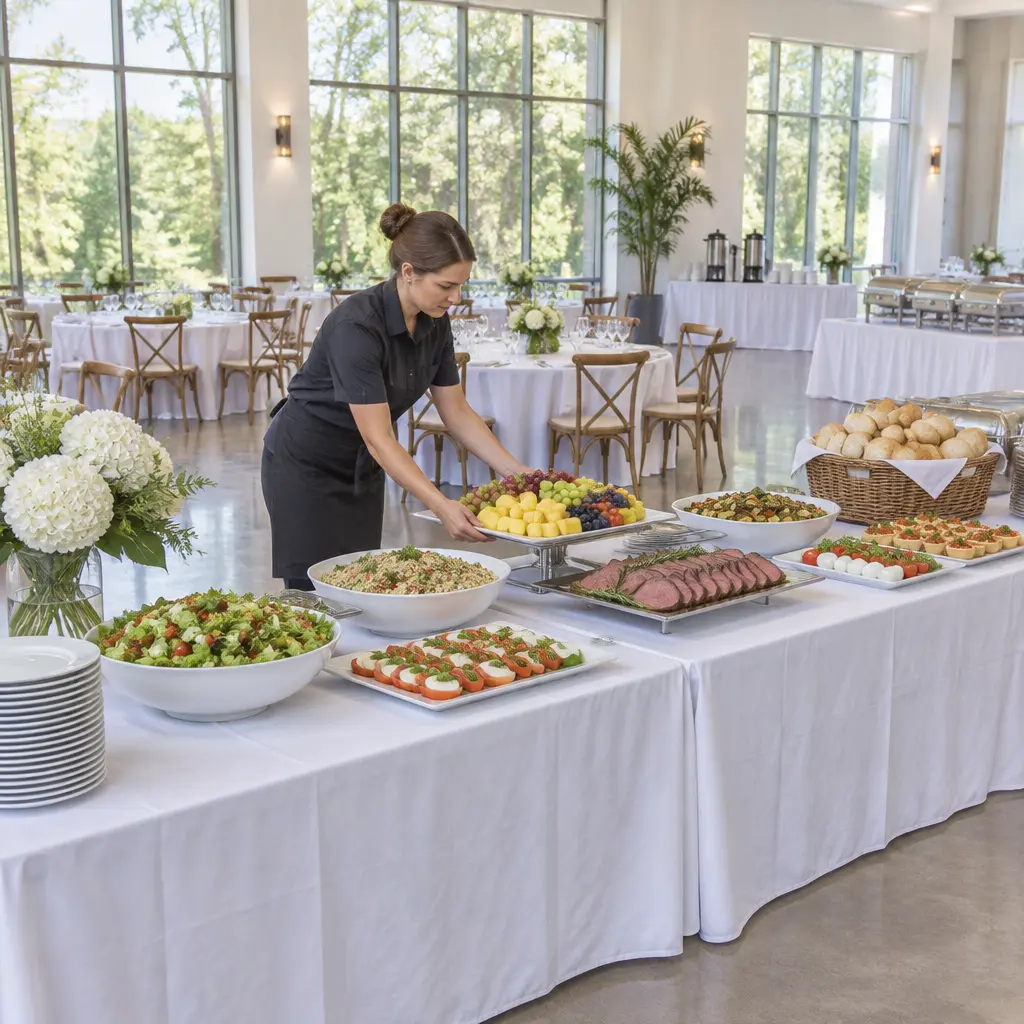
A wedding buffet can present dishes in a clear sequence, label major ingredients, and provide separate serving utensils for each item. Sauces, bread, and toppings can be placed apart from dishes they might contaminate. Guests with medical needs should still have a direct way to confirm preparation details, because buffet labels cannot describe every potential cross-contact route or substitute ingredient.
A School or Community Meal Requires Extra Attention to Allergens
The CDC’s estimate that roughly 1 in 13 U.S. children has a food allergy underscores why school and youth-event menus require clear communication and dependable procedures. Organizers should follow applicable school, public-health, and local policies, confirm requirements with caregivers through established channels, and ensure staff know how to respond to an exposure or emergency. A menu plan is not a substitute for an organization’s medical response procedures.
Evaluation Measures Whether Inclusive Menu Design Is Working
Evaluation is the review of whether dietary needs were identified, accommodated, communicated, and served as intended. Useful measures include the share of requests confirmed before the event, the number of menu items with verified ingredient information, meal-delivery accuracy, guest feedback, and any reported service or safety incidents. These measures help distinguish a polished menu from a reliable system.
A post-event review should ask whether guests had meaningful choices, whether accommodations arrived on time, and whether any label or recipe was inaccurate. Record process improvements without retaining unnecessary sensitive personal information. A chart could compare request confirmation, meal accuracy, and guest satisfaction across events, while an allergen matrix could show verified ingredients by dish; both make gaps visible without exposing individual guests.
Conclusion: Custom Menus Make Inclusion Part of the Shared Meal
Inclusive custom menus begin with a clear definition of dietary needs, then connect guest intake to ingredient verification, kitchen controls, and dependable service. Shared-menu planning and equivalent presentation reduce unnecessary segregation, while individualized plates remain essential when safety or specific requirements call for them. The FDA’s list of nine major food allergens and the CDC’s estimate that about 1 in 13 U.S. children has a food allergy demonstrate why these details are operational priorities, not decorative menu features.
Hosts and caterers should invite dietary information early, verify recipes and suppliers, train service teams, communicate limitations honestly, and review outcomes after each event. Further guidance is available from the FDA on food allergens, the CDC on food allergies, and the U.S. Department of Agriculture’s Food Safety and Inspection Service on safe food handling. The broader aim is straightforward: make every guest’s place at the table ordinary, respected, and supported by a process that takes their needs seriously.
Sources: U.S. Centers for Disease Control and Prevention, Food Allergies in Schools, https://www.cdc.gov/school-health-conditions/chronic/food-allergies.html; Food Allergy Research & Education, Food Allergy Facts and Statistics for the U.S., https://www.foodallergy.org/resources/facts-and-statistics; U.S. Food and Drug Administration, Food Allergies, https://www.fda.gov/food/food-labeling-nutrition/food-allergies; U.S. Food and Drug Administration, Food Allergen Labeling and Consumer Protection Act of 2004 Questions and Answers, https://www.fda.gov/food/food-allergensgluten-free-guidance-documents-regulatory-information/food-allergen-labeling-and-consumer-protection-act-2004-questions-and-answers; U.S. Food and Drug Administration, Food Code, https://www.fda.gov/food/retail-food-protection/fda-food-code; U.S. Department of Justice, Americans with Disabilities Act Title III Regulations, https://www.ada.gov/law-and-regs/regulations/title-iii-regulations/