Wedding Catering Logistics: Choosing a Caterer for Kitchen Capacity, Service Flow, and Menu Reliability
Wedding catering is the coordinated preparation, transport, and service of food for a wedding; choosing a caterer on kitchen logistics means evaluating whether the team can safely produce and serve the planned meal at the venue, not relying on tasting impressions alone. A tasting can reveal flavor and presentation, but it cannot show whether a caterer has enough equipment, staff, hot-holding capacity, and access time to serve hundreds of guests on schedule. The U.S. Centers for Disease Control and Prevention reports that foodborne illness causes about 48 million illnesses in the United States each year, underscoring why food safety and temperature control belong in the selection process. Couples should therefore assess venue kitchen fit, staffing and service flow, food-safety controls, and menu resilience before treating a tasting as confirmation.
Wedding catering logistics define a caterer’s operational fit
“Kitchen logistics” is a practical selection criterion rather than a single standardized industry term. In this context, it means the people, equipment, space, schedule, transport, utilities, and food-safety procedures required to prepare and serve a specific wedding menu at a specific venue. The U.S. Food and Drug Administration’s Food Code establishes a model framework for safe food handling, including temperature controls; local authorities adopt and enforce their own applicable rules. A strong proposal should explain how the caterer will meet venue requirements and applicable local regulations, not merely promise that the menu will taste good.
The operational fit has several connected parts: production capacity, the venue’s kitchen and loading conditions, service format, staffing, and contingency planning. These factors interact. For example, a plated menu may be feasible in a fully equipped kitchen with sufficient cooks and service staff, yet impractical in a venue with limited refrigeration, no commercial oven, or a short setup window. The venue manager and caterer should confirm the details together before a contract is finalized.
Venue kitchen capacity and equipment
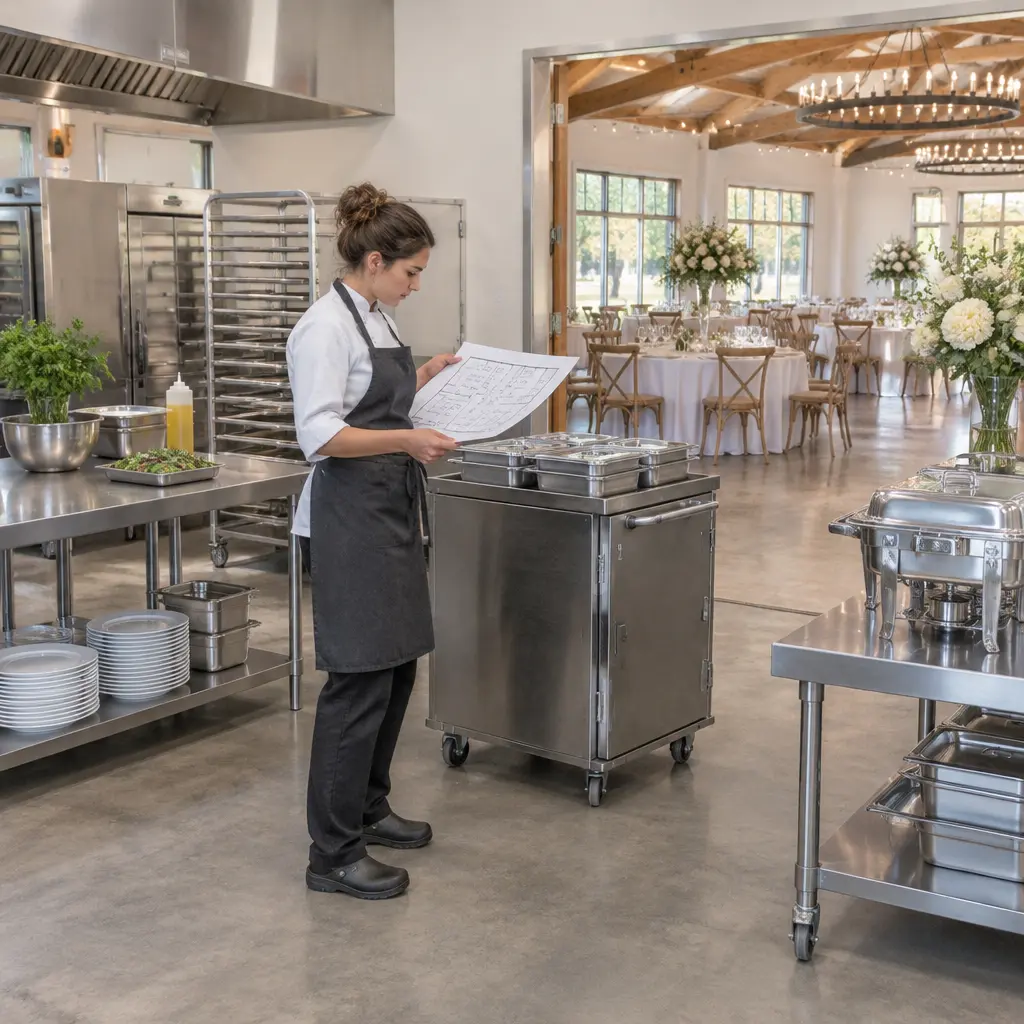
Kitchen capacity is the ability to produce the required number of portions safely and consistently using the space, appliances, utilities, and access time actually available. Ask for an equipment and workflow review: ovens, burners, refrigeration, handwashing facilities, sinks, food-preparation surfaces, electrical capacity, ventilation, and hot-holding equipment. Also confirm whether the caterer brings equipment or depends on venue-provided appliances, and who is responsible for setup, breakdown, cleaning, and waste removal.
A site visit is more informative than a generic statement that the caterer “works at the venue.” The team should verify loading-dock access, stairs or elevators, parking, distance from kitchen to dining area, storage, and restrictions on open flames or outside equipment. The U.S. Environmental Protection Agency’s ENERGY STAR guidance notes that commercial kitchens rely on multiple energy-intensive appliances; for event planning, that is a reminder to check power and equipment needs rather than assume a venue’s outlets can support every setup. Request a written equipment list and a plan for any critical appliance failure.
Staffing and service flow
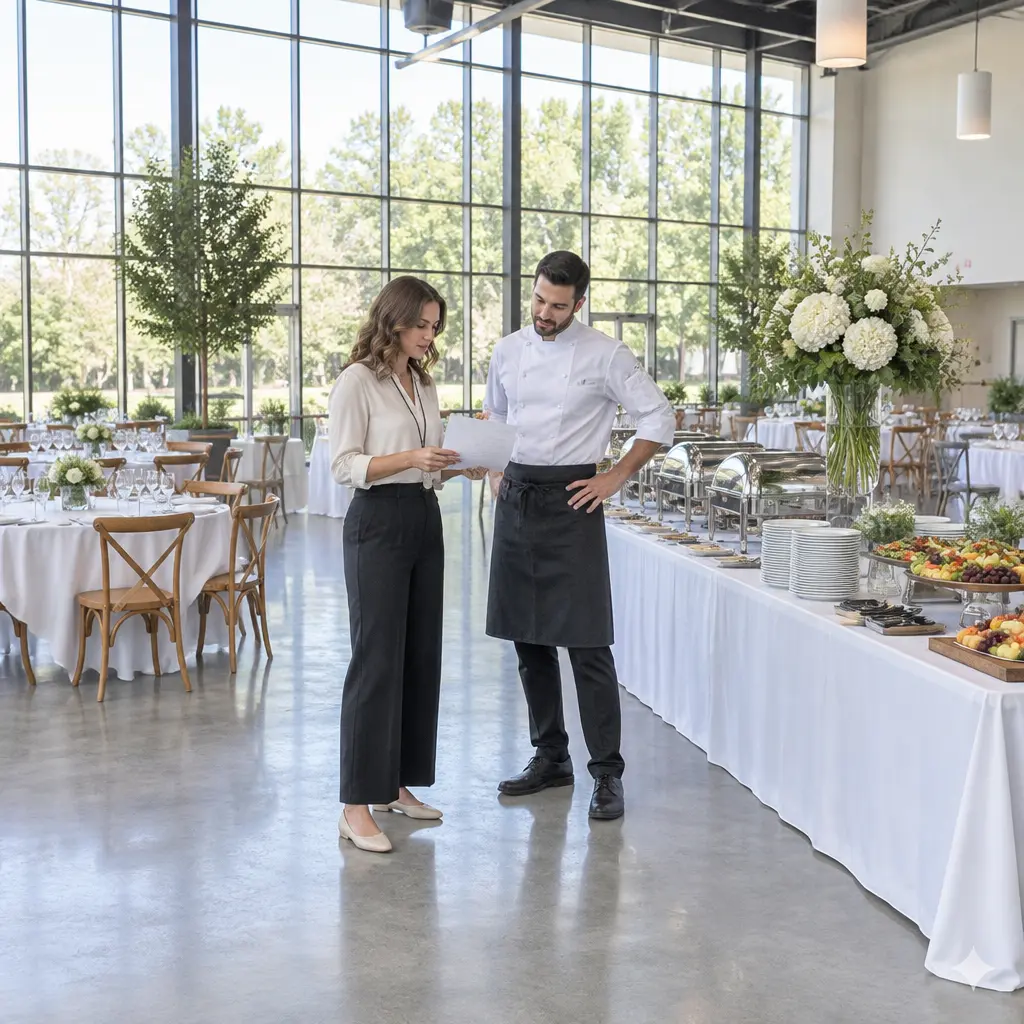
Service flow is the sequence through which food moves from preparation to guests, including cooking, plating or buffet replenishment, transport, and clearing. The caterer should provide a staffing plan that identifies the event lead, kitchen roles, servers, bartenders, and any staff assigned to dietary requests. Ask how many guests each service station or server team must handle and how that changes for a plated dinner, buffet, family-style meal, or food stations.
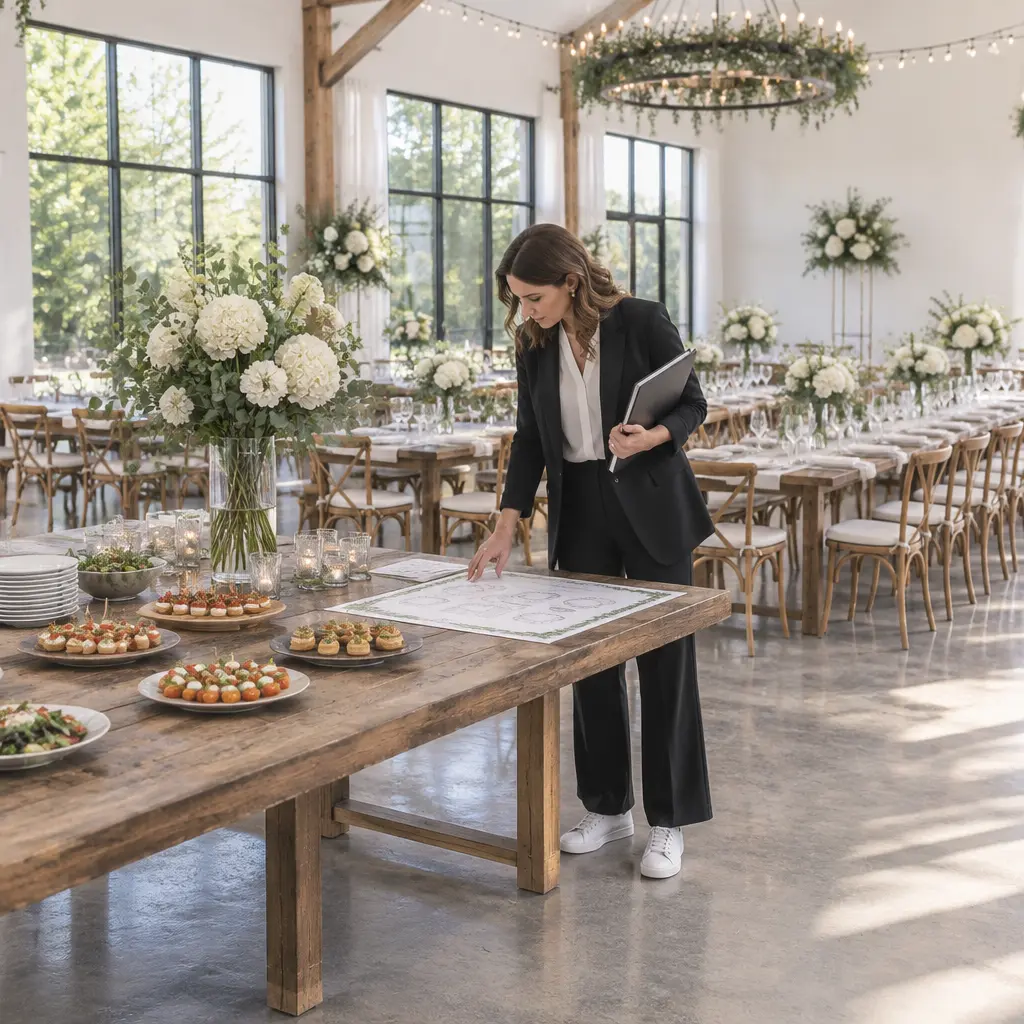
There is no universal server-to-guest ratio that guarantees good service: staffing depends on menu complexity, room layout, guest mobility, service style, and event timing. Instead, request a minute-by-minute service schedule tied to the wedding timeline. It should account for speeches, late arrivals, transitions between ceremony and reception, and the time needed to serve guests with allergies or special meals. A useful planning graphic is a “service-flow map” showing kitchen, staging areas, dining room, and replenishment routes; it can expose bottlenecks before the event.
Food safety, transport, and temperature control
Food safety logistics cover how ingredients and prepared dishes are received, stored, cooked, transported, held, and served. The FDA Food Code is a model code for retail and food-service safety, while the applicable state or local health authority determines enforceable requirements. The FDA’s widely used Food Code framework generally calls for cold holding at 41°F (5°C) or below and hot holding at 135°F (57°C) or above, subject to the jurisdiction’s adopted code and specific food-handling rules.
Ask the caterer how it monitors temperatures, prevents cross-contact between allergens, transports food, and responds to delays or equipment problems. The CDC estimates that roughly one in six Americans gets sick from foodborne illness each year, making documented controls more than a formality. A professional answer should identify responsible staff, thermometers or monitoring procedures, secure refrigeration and hot-holding arrangements, and the process for communicating dietary needs to kitchen and service teams.
Wedding menu reliability depends on matching food to operations
Menu reliability is the likelihood that a dish can be delivered at the intended quality, temperature, and timing for the full guest count under the venue’s actual conditions. A tasting validates a sample prepared in controlled circumstances. It does not, by itself, validate large-batch production, travel, holding time, or simultaneous service. The best menu is therefore not necessarily the most elaborate one; it is a menu the caterer can reproduce consistently within the event’s constraints.
Menu complexity and batch production
Batch production is preparing food in quantities and stages that allow a large group to be served without sacrificing safety or consistency. Ask which dishes are cooked on site, which are prepared in advance, and how each component is finished and held. Delicate fried foods, dishes requiring last-minute à la minute cooking, and items that deteriorate during extended holding may need special equipment, additional cooks, or a different service format.
Request a production plan for the actual guest count, including the caterer’s assumptions about arrival time, kitchen access, and service start. If the menu includes several courses, ask how the kitchen will prevent one course from delaying the next. A credible caterer can explain which dishes are robust at scale and where a substitution would preserve quality if the venue’s equipment or schedule changes.
Service style as a logistics decision
Plated, buffet, family-style, and station service are different operating models, not simply presentation choices. Plated service requires coordinated kitchen output and enough servers to deliver meals efficiently. Buffets require suitable layout, replenishment, temperature control, and a plan to manage queues. Family-style service needs table space, serving dishes, and enough food moved to each table. Stations can distribute guests across a room but may need more equipment and staff.
Choose the format after discussing the room plan, guest count, mobility needs, and timeline with both venue and caterer. For example, a buffet may reduce the need for simultaneous plating but can create lines if there are too few serving points. A plated meal may feel orderly but can be vulnerable to delays when the kitchen has limited oven or staging capacity. The caterer should explain the trade-offs in measurable terms, such as planned service duration and the number of stations or staff.
Dietary needs and allergen controls
Dietary accommodation is an operational requirement involving accurate guest counts, ingredient verification, preparation controls, clear identification, and delivery to the correct guest. Ask how the caterer records allergies and dietary requests, prevents cross-contact, labels special meals, and confirms their delivery with the event lead. “Vegetarian” or “allergy-friendly” should be backed by a specific process rather than an informal note on a seating chart.
The FDA identifies nine major food allergens in the United States: milk, eggs, fish, crustacean shellfish, tree nuts, peanuts, wheat, soybeans, and sesame. This list can help structure questions, but it does not replace individual guest communication or local rules. Share confirmed requirements by the caterer’s stated deadline, and ask whether a special meal is prepared separately or merely modified at service. The plan should also cover changes in guest count and last-minute substitutions.
A wedding catering selection process tests logistics before taste
A practical selection process starts with operational screening, then uses the tasting to evaluate the dishes the caterer has shown it can execute at the venue. This order helps couples compare proposals on comparable assumptions and reduces the risk of selecting a memorable tasting that depends on unavailable equipment or unrealistic staffing.
- Obtain the venue’s kitchen inventory, access rules, loading instructions, and restrictions.
- Give each candidate the same guest count, service style, event schedule, dietary requirements, and venue information.
- Request a written staffing plan, equipment list, production timeline, food-safety procedures, and contingency plan.
- Ask the caterer to explain how the proposed menu will be cooked, transported, held, and served under those conditions.
- Conduct a tasting of the proposed dishes, then confirm that the tasting methods and ingredients reflect the operational plan.
- Put agreed responsibilities, service scope, overtime terms, rentals, cleanup, and change deadlines into the contract.
Questions that reveal operational readiness
Useful questions request specific evidence rather than broad assurances. Ask: “Have you served this guest count in this venue?” “How many hours of kitchen access do you need?” “What equipment must the venue supply?” “Who monitors food temperatures?” “How will you serve special meals?” “What happens if an oven fails or the reception runs late?” and “Which costs change if the final guest count changes?” A clear, consistent answer is more valuable than an impressive menu description.
A simple comparison table can score each candidate on kitchen fit, staffing, safety, menu reproducibility, dietary controls, contingency planning, and total cost. Weight the categories according to the event’s priorities, but treat any unresolved food-safety or venue-access issue as a condition to resolve before booking. The tasting can then distinguish flavor and presentation among caterers that have already passed the operational screen.
Contracts, contingencies, and real-world application
A catering contract translates the operational plan into responsibilities and limits. It should identify the final guest-count deadline, menu and substitution terms, staffing scope, rentals, setup and cleanup duties, access and overtime charges, dietary-meal procedures, and the response to equipment or schedule disruptions. Confirm who supplies water, ice, power, refrigeration, and waste handling when those items are not included by the venue.
Consider a reception in a historic venue with limited refrigeration and a long route from the loading entrance to the dining room. A caterer that proposes a complex menu but cannot explain cold storage, transport carts, or replenishment may be a poor fit, even if the tasting is excellent. A more suitable team might recommend a menu with components that hold safely, bring appropriate equipment, and stage service in timed batches. This example illustrates the central decision: assess whether the plan works in the room before judging whether the sample works on the plate.
Conclusion: prioritize wedding catering logistics, then confirm the menu
Wedding catering selection is strongest when venue capacity, staffing and service flow, food safety, menu reliability, and contractual responsibilities are evaluated as one connected system. A tasting remains useful, but it cannot establish kitchen access, safe holding, production capacity, or service timing. Review the venue with prospective caterers, request written operating plans, and resolve gaps before signing. Couples who want to go further can consult their local health department’s food-service rules, the FDA Food Code, and the venue’s technical specifications before making a final menu decision.
Sources: Centers for Disease Control and Prevention, Estimates of Foodborne Illness in the United States, https://www.cdc.gov/foodborneburden/2011-foodborne-estimates.html; U.S. Food and Drug Administration, 2022 Food Code, https://www.fda.gov/food/fda-food-code/food-code-2022; U.S. Food and Drug Administration, Food Allergies, https://www.fda.gov/food/food-labeling-nutrition/food-allergies; U.S. Environmental Protection Agency, ENERGY STAR Guide for Cafés, Restaurants, and Institutional Kitchens, https://www.energystar.gov/buildings/resources_audience/restaurant_owners_and_operators