
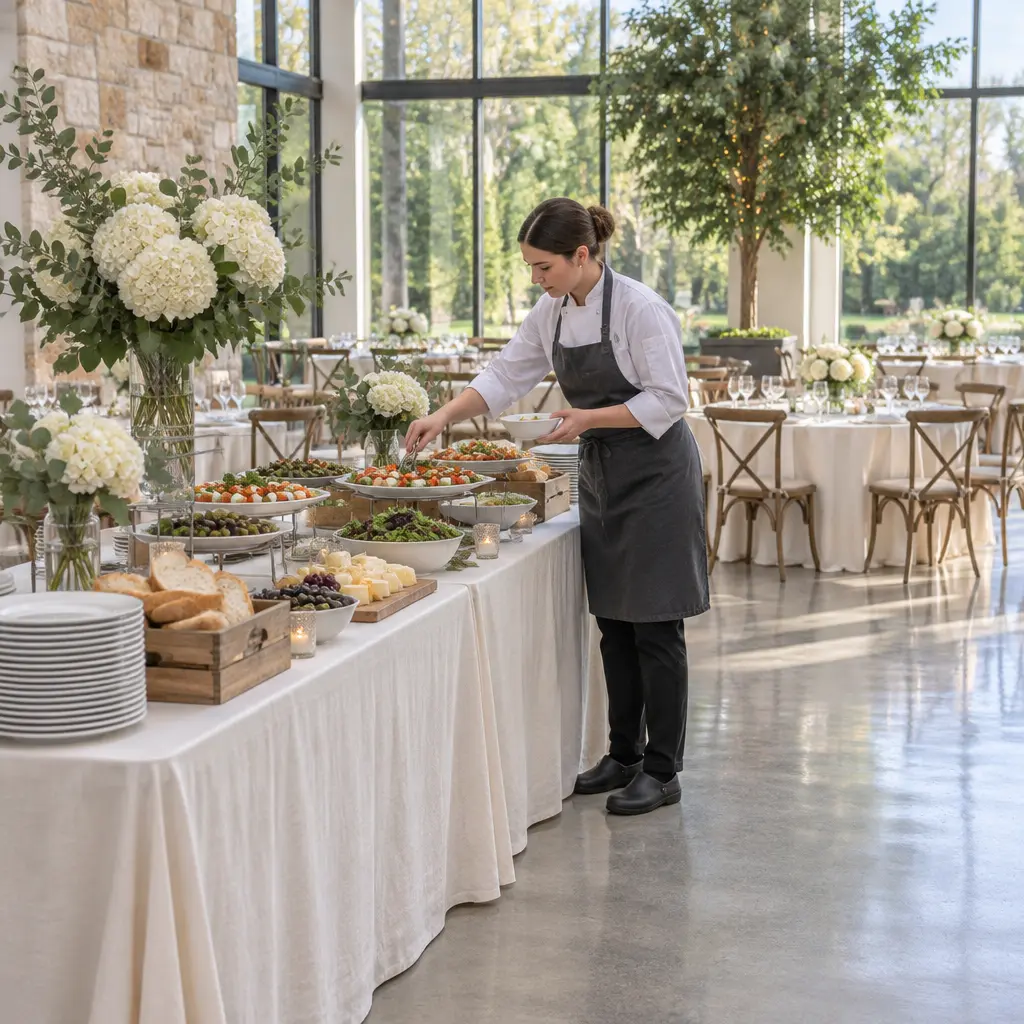
Wedding catering food waste is edible or inedible food discarded during planning, preparation, service, or cleanup. Couples and caterers can reduce it by forecasting attendance carefully, designing flexible menus, serving food in manageable batches, arranging safe donation or reuse, and measuring leftovers. The scale makes these steps worthwhile: the United Nations Environment Programme’s Food Waste Index Report 2024 estimates that 1.05 billion tonnes of food were wasted worldwide in 2022, including food from food service. At a wedding, thoughtful portioning and a clear end-of-event plan can help prevent waste while protecting guest experience, food safety, and the budget.
Reducing food waste through wedding catering planning
Food-waste reduction in wedding catering means preventing surplus food where possible and safely redirecting unavoidable edible surplus instead of sending it to disposal. The U.S. Environmental Protection Agency (EPA) places prevention and donation above composting and landfill disposal in its Wasted Food Scale, because preventing waste preserves the resources used to produce, transport, and prepare food. For wedding teams, that hierarchy translates into a practical sequence: plan accurately, use ingredients efficiently, serve food in controlled quantities, donate eligible surplus, and compost suitable scraps when prevention is not possible.
The opportunity is both environmental and operational. The EPA’s 2019 estimate found that 66 million tons of wasted food were generated in the U.S. residential, commercial, and institutional sectors combined; roughly 60% went to landfills. Wedding-specific waste varies by guest count, menu, venue, and service style, so a single universal estimate is unreliable. A better approach is to measure a particular event and use that evidence to improve its next planning decision.
Set a waste-prevention hierarchy before booking
A waste-prevention hierarchy ranks actions by how well they retain food’s value. First prevent surplus through accurate ordering and preparation; next, redirect safe, edible food for people; then consider animal feed or composting where permitted; use disposal only as a last resort. EPA’s Wasted Food Scale identifies prevention and donation as preferable to less beneficial pathways such as landfill or incineration.
Couples can make this hierarchy actionable by asking prospective caterers how they forecast portions, track kitchen scraps, manage buffet replenishment, and handle unserved food. Put agreed responsibilities in writing, including who may approve donation, which organizations can collect food, and what happens if a pickup falls through. Local health rules and the venue’s policies still apply.
Use measurement to guide decisions
Measurement means recording what is prepared, served, left edible, and discarded. A simple event log can separate food prepared but never served from plate leftovers and preparation scraps. Weighing each category—or recording container counts and estimated weights consistently—helps identify whether the main opportunity is purchasing, portion size, menu selection, or service design.
The EPA’s Food Recovery Challenge resources encourage organizations to track wasted food and set reduction goals. A wedding can apply the same principle on a smaller scale: establish a baseline at one event, then compare results at a later event or against the caterer’s own past events. Avoid treating a weight reduction as the only success measure; food safety, guest satisfaction, and reliable service matter too.
Preventing surplus through guest forecasting and menu design
Guest forecasting is the process of turning confirmed attendance and event details into realistic food quantities. It is more useful than simply ordering a generous amount “just in case.” The caterer should base its production plan on the final guaranteed guest count, meal format, event schedule, menu choices, and any relevant service constraints, while retaining an agreed contingency for genuine uncertainty.
Menu design works alongside forecasting. A thoughtfully balanced menu can limit duplication, make use of shared ingredients, and accommodate dietary needs without requiring large quantities of little-used alternatives. The bridge from accurate headcounts to efficient menus is coordination: planners, couples, venues, and caterers need to share final numbers and changes promptly.
Confirm attendance and service details
A final guest count is the caterer’s principal quantity-planning input, but it should be accompanied by details that affect consumption: children’s meals, vendor meals, meal timing, reception length, and the number of guests who need specific dietary accommodations. The U.S. Department of Agriculture’s Food Loss and Waste resources emphasize that better planning and inventory management can prevent avoidable surplus throughout the food chain.
Set a clear RSVP deadline and a separate deadline for the caterer’s guaranteed count. Share updates as soon as they are known rather than relying on an early estimate. Ask the caterer to explain how its portion assumptions change between a plated meal, buffet, cocktail reception, and late-night service; these formats do not necessarily call for identical quantities.
Choose menus that use ingredients efficiently
An efficient menu uses ingredients across several dishes without making the meal repetitive. For example, a seasonal vegetable may appear in a starter and a side, while sturdy herbs can be incorporated into sauces or garnishes. Seasonal purchasing can also support availability, but it does not automatically prevent waste; the caterer still needs a workable plan for storage, preparation, and any surplus.
Limit unnecessary menu complexity and ask which components are prepared in advance versus finished to order. A very broad selection can leave small amounts of many dishes, whereas a focused menu may be easier to forecast. Dietary alternatives should be clearly identified and portioned to meet confirmed needs, with a modest, agreed contingency rather than an untracked excess.
Plan portions around the event experience
Portion planning matches serving sizes to the meal’s role in the event. A cocktail hour with substantial canapés, a plated dinner, cake, and a late-night snack creates a different pattern of appetite from a short ceremony followed by a single meal. Ask the caterer to consider the full schedule instead of estimating each food station in isolation.
Offer suitable serving sizes and, where practical, allow guests to request more rather than defaulting to oversized portions. For buffet service, smaller serving dishes can be replenished as needed, helping the kitchen keep backup food at safe temperatures. This approach can reduce exposed surplus while ensuring the display remains inviting.
Managing food waste during wedding service
Service management covers the decisions made as food moves from the kitchen to guests and then through clearing and storage. Even a well-forecast menu can produce waste if stations are overfilled, food is held too long, or staff do not know which items may be safely reused. Clear communication between the kitchen, floor team, venue, and planner connects prevention with food safety.
The U.S. Food and Drug Administration’s Food Code provides a model for food-safety regulation, although local and state requirements determine what applies at a particular venue. Caterers should follow applicable time-and-temperature controls and their documented food-safety procedures. Waste reduction must never depend on serving food that has been handled or held unsafely.
Serve buffets in controlled batches
Batch service means presenting a manageable quantity while keeping additional food in the kitchen until it is needed. It is particularly useful for buffets and stations, where a full display can look abundant but leave food exposed for long periods. Staff can replenish dishes in smaller amounts, use appropriately sized serving vessels, and monitor attendance before preparing or displaying more.
The caterer should decide which foods can be replenished from protected backup and which items must be discarded after service, based on local rules and safe handling. Labeling dishes and assigning a staff member to monitor each station can prevent unnecessary refills and reduce confusion about allergens and dietary options.
Coordinate timing, storage, and kitchen communication
Food timing influences both quality and safety. Delays between preparation and service, extended speeches, or a late schedule change can affect how much food remains suitable to serve. A run sheet should identify meal times, who communicates delays, and who has authority to adjust production or replenishment.
Make sure the venue and caterer agree in advance on refrigeration, cooling, packaging, and access to storage. Food intended for donation or later use must meet applicable handling and temperature requirements; it should not be set aside without a safe process. The FDA Food Code is a model document, so couples should ask the caterer to follow the rules adopted by the relevant local authority.
Redirecting safe surplus after the reception
Food recovery is the safe redirection of edible surplus to people or other beneficial uses instead of disposal. The EPA prioritizes donating wholesome, uneaten food for people after prevention. However, not every leftover is eligible: food that has been served to guests, exposed to uncontrolled conditions, or handled outside applicable requirements may not be suitable for donation.
Recovery works best when it is arranged before the wedding. A named recipient, confirmed pickup time, suitable packaging, and a designated caterer or venue contact reduce the risk that food will be left without a safe destination. If donation is unavailable, ask about permitted composting or other local recovery options.
Arrange donation with a qualified recipient
A food donation partner is an organization that accepts eligible surplus and distributes it through an established process. Contact a local food bank, meal program, or food-rescue organization well before the event to confirm what it accepts, when it can collect, and how food must be packaged and labeled. Do not assume that a recipient can accept every dish or collect at any hour.
The U.S. Bill Emerson Good Samaritan Food Donation Act provides liability protections for certain good-faith food donations to nonprofit organizations, subject to the law’s conditions. It does not replace food-safety duties or guarantee that every donation is covered. Caterers and couples should confirm current federal, state, and local requirements and follow the recipient’s handling instructions.
Separate edible surplus from scraps and plate waste
Edible surplus is food that has not been served and can be safely redirected under applicable rules. Plate waste and preparation scraps are different categories and typically cannot be donated for people. Separating these streams makes it easier to identify donation candidates and choose suitable composting or other disposal options for the remainder.
Use clearly marked bins and instruct staff not to mix unopened, untouched food with scraps. Ask the venue whether it accepts food scraps for composting and whether packaging, bones, oils, or liquids must be separated. EPA guidance places composting below prevention and donation in the preferred hierarchy, but it may be a better destination than landfill for suitable unavoidable scraps.
Make guest take-home plans practical
Take-home packaging can help guests enjoy eligible leftovers, but it should not be treated as a substitute for forecasting or a food-safety plan. Confirm who will package food, what containers are suitable, and which items can be safely offered. A visible, optional arrangement is usually more practical than expecting guests to manage food themselves during the event.
If food is packed for guests, provide it promptly and communicate any relevant storage guidance. The caterer should determine whether the food has remained within safe handling conditions. When that cannot be established, discard it responsibly rather than distributing food of uncertain safety.
A practical wedding food-waste checklist
A checklist turns the principles of forecasting, service control, and recovery into assigned tasks. The couple does not need to manage kitchen operations directly; instead, the aim is to agree on responsibilities with the caterer and venue before contracts and schedules are finalized.
- Ask the caterer how it estimates quantities for the chosen service style.
- Set RSVP and final-count deadlines, and promptly share attendance changes.
- Review the full event schedule, including cocktail hour, cake, and late-night food.
- Choose a menu that uses ingredients efficiently and accounts for confirmed dietary needs.
- Agree on batch replenishment, storage, and food-safety responsibilities.
- Identify a donation recipient in advance and confirm accepted foods and pickup logistics.
- Ask the venue about composting and rules for separating scraps and packaging.
- Record prepared food, edible surplus, plate waste, and scraps after the event.
For example, a caterer serving a buffet could keep most backup food in the kitchen, replenish smaller display dishes as guest demand becomes clear, and record what remains after service. If eligible unserved food has a prearranged recipient and meets handling rules, it may be donated; inedible scraps can be separated for a venue-approved composting program. The example illustrates a process, not a guaranteed outcome: local rules and the event’s actual conditions determine what can be recovered.
Conclusion: make lower-waste catering part of the plan
Reducing food waste at a wedding starts with accurate forecasting and efficient menu design, continues through controlled service and safe handling, and ends with planned donation or appropriate processing of unavoidable scraps. The EPA’s food-recovery hierarchy supports preventing surplus first and prioritizing edible food for people when safe and practical. Measuring leftovers makes future planning more precise, while clear roles help protect both guest experience and food safety.
Couples can take action now by asking caterers about portion assumptions, replenishment practices, donation partnerships, and waste tracking. Build the answers into the event plan, confirm local requirements with the caterer and venue, and use the post-event results to improve future celebrations. Small, coordinated decisions can reduce needless waste without compromising hospitality.
Sources: United Nations Environment Programme, Food Waste Index Report 2024, https://www.unep.org/resources/publication/food-waste-index-report-2024; U.S. Environmental Protection Agency, Wasted Food Scale, https://www.epa.gov/sustainable-management-food/wasted-food-scale; U.S. Environmental Protection Agency, Sustainable Management of Food: Food Recovery Hierarchy, https://www.epa.gov/sustainable-management-food/food-recovery-hierarchy; U.S. Environmental Protection Agency, 2019 Wasted Food Report, https://www.epa.gov/land-research/2019-wasted-food-report; U.S. Environmental Protection Agency, Food Recovery Challenge, https://www.epa.gov/sustainable-management-food/food-recovery-challenge-frequent-questions; U.S. Department of Agriculture, Food Loss and Waste, https://www.usda.gov/about-food/food-safety/food-loss-and-waste; U.S. Food and Drug Administration, Food Code, https://www.fda.gov/food/retail-food-protection/fda-food-code; U.S. Congress, Bill Emerson Good Samaritan Food Donation Act, https://www.congress.gov/bill/104th-congress/house-bill/2428.


