
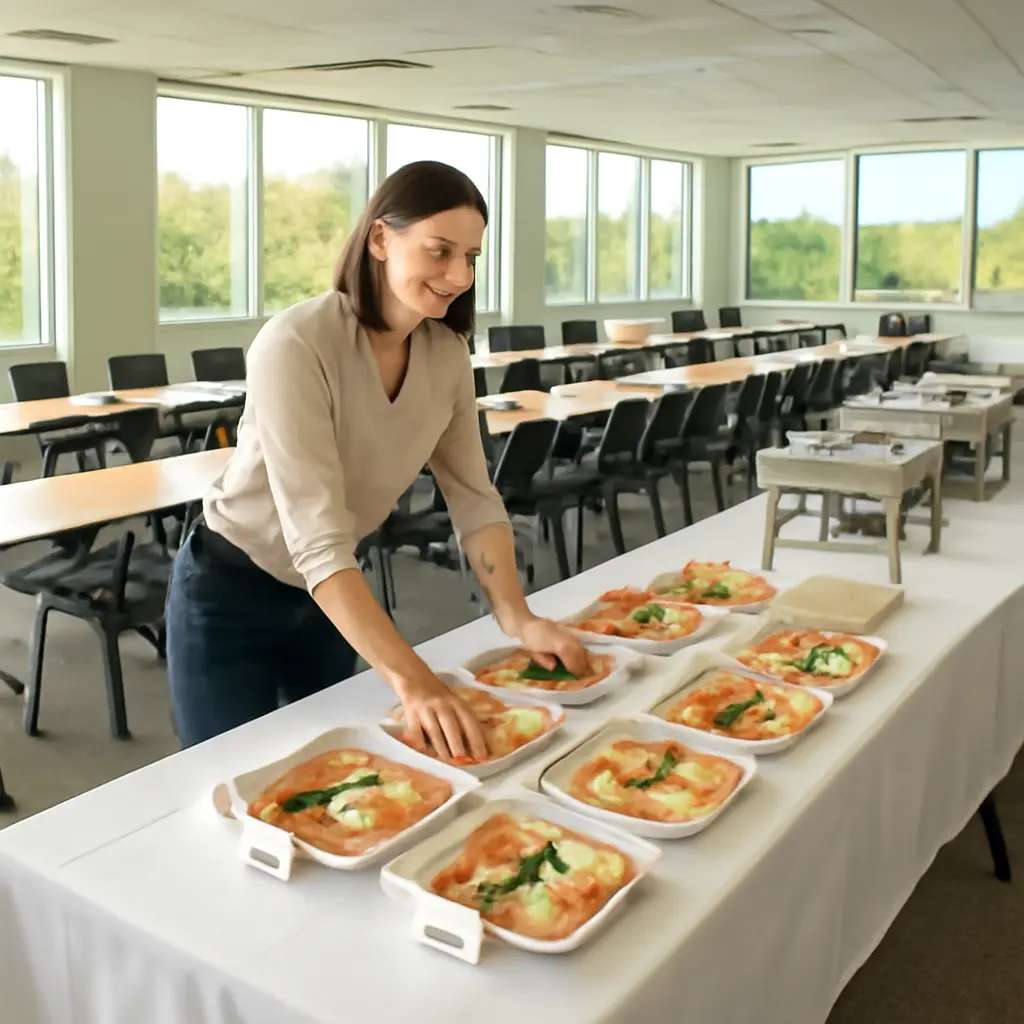
Modern lunch catering is the planned provision of food and service for daytime gatherings, from working lunches and training sessions to conferences and community events. It is changing as organizers favor flexible formats, convenient ordering, dietary choice, and food that can be served efficiently within a limited schedule. The National Restaurant Association’s 2024 industry outlook identified off-premises dining as an established consumer behavior, while its catering research has highlighted demand for convenient group meals. Together, these trends help explain why today’s catered lunch is less a standard tray of sandwiches and more an event service designed around its guests, venue, and timetable.
Modern lunch catering adapts to changing daytime events
Lunch catering means preparing, delivering, and often serving food for a group outside a restaurant’s usual dining room. The U.S. Small Business Administration describes catering as a food-service business that supplies meals for events and other occasions; in practice, the format ranges from individually packaged lunches to staffed buffets. Modern providers apply that basic model to more varied daytime events, where organizers may need reliable timing, clear dietary information, and a service style that fits a meeting rather than a formal dinner.
The shift matters because daytime programs often run on tight agendas. A meal may be a brief pause between presentations, a networking opportunity, or the main hospitality moment of a workplace gathering. The U.S. Bureau of Labor Statistics’ American Time Use Survey consistently finds that eating and drinking are everyday activities concentrated around predictable parts of the day, making lunch a practical anchor for event schedules. The design challenge is to serve food that feels considered without slowing the event down.
From formal banquet to flexible group dining
Traditional catering often centered on plated service or a buffet with a fixed menu. Contemporary lunch catering also includes boxed meals, drop-off spreads, food stations, individually selected orders, and hybrid arrangements. These are related forms of the same service: each matches a different balance of guest interaction, staffing, venue access, and available meal time.
Convenience is now an event requirement
Convenience does not mean treating food as an afterthought. It means reducing friction for both hosts and attendees: ordering is straightforward, delivery windows are realistic, meals are easy to identify, and service fits the room. The National Restaurant Association’s 2024 State of the Restaurant Industry report describes digital ordering and off-premises dining as important parts of restaurant operations, context that has helped normalize delivery and pickup for group meals as well as individual orders.
Lunch catering formats fit different event needs
A catering format is the way a meal is packaged, presented, and served. Choosing one depends on guest count, event length, venue rules, staffing, budget, and whether guests need to eat while continuing to work. The best choice is not necessarily the most elaborate one; it is the service model that supports the event’s purpose.
Boxed lunches support compact schedules
A boxed lunch is an individually packed meal, commonly including a main item, sides, and sometimes a drink or dessert. It is useful for trainings, off-site meetings, field events, and conferences where guests need to collect food quickly or eat at their seats. Clear labels can identify ingredients and dietary options, while consistent packaging simplifies distribution. Hosts should still plan for waste sorting, temperature control, and enough time for delivery and setup.
Buffets and food stations encourage choice
A buffet presents multiple dishes for guests to serve themselves; a food station is a more focused version, often organized around a cuisine or preparation style. Both can suit networking events and longer breaks because they offer variety and create opportunities for conversation. Their trade-offs include queues, the space needed for guest circulation, and the need to keep hot and cold foods at safe temperatures. The U.S. Food and Drug Administration’s Food Code provides the model framework used by many jurisdictions for food-safety practices, including holding and handling requirements.
Drop-off catering minimizes staffing needs
Drop-off catering delivers ready-to-serve food and setup materials without providing full-service staff throughout the event. It can be a practical option for office lunches and smaller gatherings, particularly when the host has people available to arrange the meal. Before ordering, confirm what the service includes—such as utensils, serving equipment, setup, cleanup, and collection of reusable items—so the apparent convenience does not create unexpected work for the event team.
Inclusive menus make catered lunches more useful
An inclusive catering menu provides meaningful options for guests with different dietary needs, preferences, and cultural practices. It is more than adding one token vegetarian dish: organizers need accurate ingredient information, safe handling, and enough suitable portions. Asking for requirements during registration and sharing them with the caterer early makes the menu more reliable and reduces last-minute substitutions.
Dietary accommodations require clear information
Dietary accommodations can include vegetarian and vegan meals, allergy-aware choices, and meals that meet religious or other restrictions. The U.S. Centers for Disease Control and Prevention estimates that food allergies affect about 1 in 10 adults and 1 in 13 children in the United States. That makes ingredient transparency and careful communication consequential, not merely a courtesy. A menu label should describe the dish and its relevant ingredients, while the caterer should explain cross-contact limitations honestly rather than promising a level of safety it cannot provide.
Balanced menus support a better guest experience
A balanced lunch menu offers variety in flavor, texture, and portion size without making the meal difficult to serve. Hosts can pair familiar choices with seasonal produce, provide a satisfying plant-based main, and consider lighter options for events that continue through the afternoon. The Dietary Guidelines for Americans, issued by the U.S. Departments of Agriculture and Health and Human Services, recommend patterns that emphasize vegetables, fruits, whole grains, and varied protein foods. Caterers can use that guidance as a planning reference while still tailoring menus to the occasion and guests.
Logistics and sustainability shape lunch catering quality
Catering logistics include estimating portions, coordinating delivery, arranging service space, and keeping food safe. These practical details are closely connected: a menu that looks excellent on paper can fail if it arrives late, does not fit the venue, or cannot be served at the required temperature. A planning checklist helps organizers evaluate the full service rather than comparing menus alone.
Timing, venue access, and food safety
A dependable catering plan begins with the event schedule and site conditions. Confirm the delivery entrance, elevator or loading restrictions, room access, refrigeration, electrical supply, table availability, and cleanup expectations. Ask the provider how it will manage hot and cold foods, how long setup takes, and whom to contact if the schedule changes. The FDA Food Code is a key reference for retail and food-service safety, although local and state requirements determine the rules that apply in a particular location.
Waste-conscious service balances packaging and portions
Waste-conscious catering aims to reduce surplus food and avoid unnecessary materials while maintaining safe, convenient service. The U.S. Environmental Protection Agency’s food-recovery hierarchy prioritizes preventing wasted food and donating wholesome surplus when feasible, before recycling or disposal options. Event organizers can apply that principle by requesting realistic portion estimates, confirming attendance close to the event, choosing reusable serviceware where practical, and asking the caterer how surplus food and packaging will be handled. Any donation or reuse plan must follow applicable food-safety rules.
A simple planning checklist improves results
The following questions help connect the menu to the event’s actual needs:
- How many guests are expected, and when will the final count be confirmed?
- How long is the lunch break, and will guests eat together or in shifts?
- What allergies, dietary requirements, and cultural preferences should the caterer accommodate?
- Does the venue allow outside food, and what access, equipment, or cleanup rules apply?
- What is included in the quote: delivery, setup, service staff, utensils, taxes, and cleanup?
- How will food be labeled, held at safe temperatures, and managed if the schedule changes?
- Can portions, serviceware, or surplus plans be adjusted to reduce waste?
Conclusion: Modern lunch catering serves the event, not just the meal
Modern lunch catering combines adaptable service formats, inclusive menu planning, and careful logistics. Boxed meals suit compressed schedules, buffets and stations offer choice, and drop-off service can simplify smaller gatherings. Food-allergy data underscores the need for clear labels and communication, while federal nutrition and food-recovery guidance offers useful reference points for menu and waste decisions.
For organizers, the practical next step is to define the event’s schedule, guest needs, venue constraints, and service expectations before comparing caterers. Ask providers for itemized proposals, ingredient details, delivery plans, and realistic portion recommendations. A well-planned lunch can protect the agenda while making guests feel welcome—and can make daytime events more effective, inclusive, and responsible.
Sources: National Restaurant Association, 2024 State of the Restaurant Industry Report, https://restaurant.org/research-and-media/research/research-reports/state-of-the-restaurant-industry/; U.S. Small Business Administration, Choose a Business Structure and Start Your Business resources, https://www.sba.gov/business-guide/; U.S. Bureau of Labor Statistics, American Time Use Survey, https://www.bls.gov/tus/; U.S. Food and Drug Administration, FDA Food Code, https://www.fda.gov/food/fda-food-code/food-code-2022; Centers for Disease Control and Prevention, About Food Allergy, https://www.cdc.gov/food-allergies/about/; U.S. Department of Agriculture and U.S. Department of Health and Human Services, Dietary Guidelines for Americans, 2020–2025, https://www.dietaryguidelines.gov/; U.S. Environmental Protection Agency, Sustainable Management of Food: Food Recovery Hierarchy, https://www.epa.gov/sustainable-management-food/food-recovery-hierarchy.


